
Blockchain Bible: When Blockchains Actually Make Sense (And When They Really Do Not)
A practical guide for real-world blockchain use in finance, ESG, supply chains and B2B workflows. Learn where blockchains genuinely add value and when traditional systems are better.
Everyone has been told that 'blockchain will change everything.' Reality: it will not. Blockchains are powerful for a small set of problems and pretty average or even bad for many others.
This article is a practical 'Blockchain Bible' for real world use, especially in finance, ESG, supply chains and B2B workflows. You will find: where blockchains are genuinely useful, why certain architectures work well in those cases, and what trade offs you are taking on when you choose a chain.
I will use examples of cheap, easy to deploy blockchains that support stablecoins and privacy features (for example NEXORA, and also stacks such as Quorum or Corda based networks).
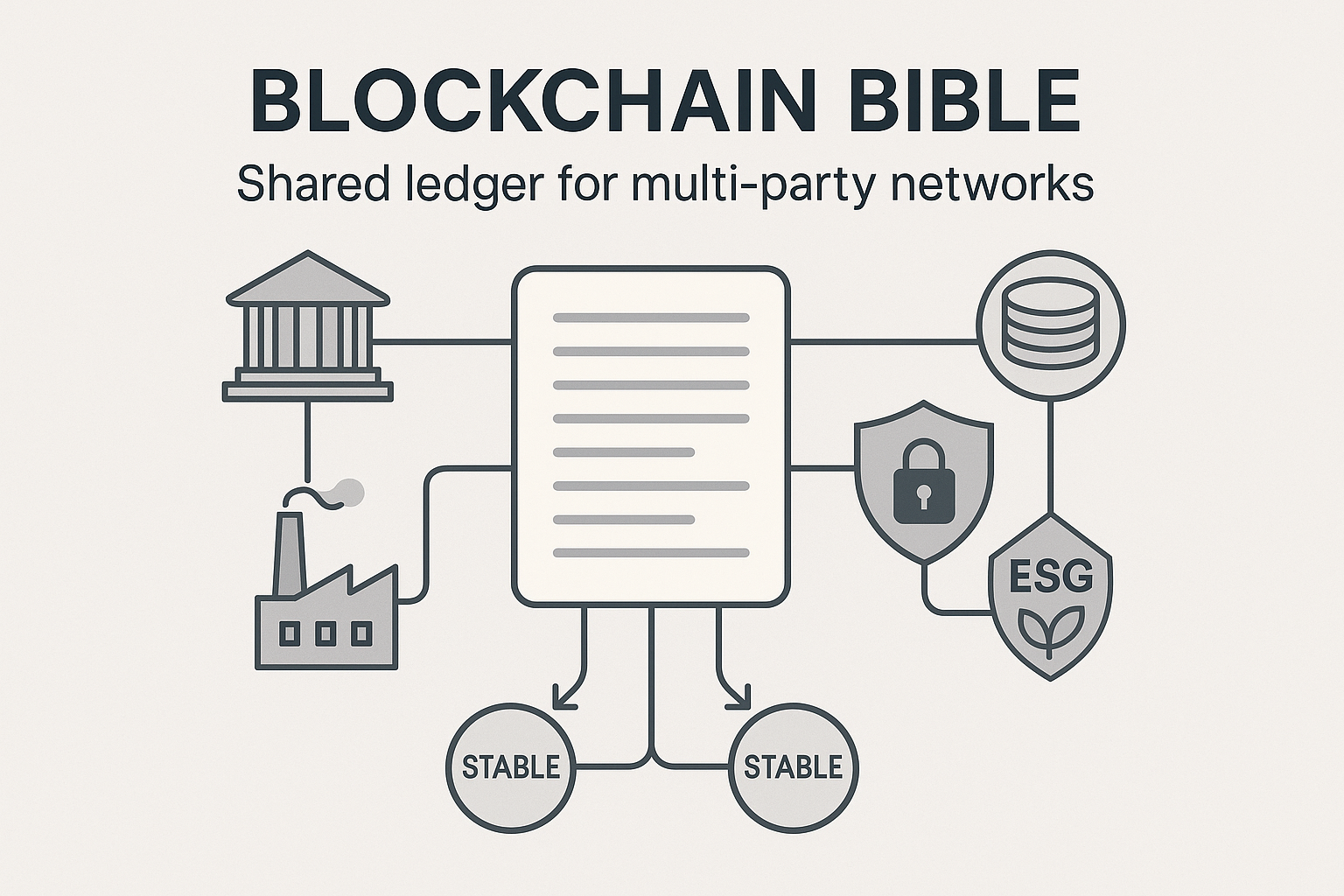
Core idea: When many companies, partners and regulators need to agree on 'who owns what' and 'what happened when,' a shared ledger can be better than twenty disconnected systems and constant reconciliation.
Examples: B2B payments and settlement, trade finance and supply chain finance, carbon, ESG and renewable energy registries, multi party marketplaces with issuers, buyers, verifiers and auditors.
In the traditional model, each party keeps its own ledger, then reconciles with everyone else. In a shared ledger model, the network itself is the ledger. There is one canonical sequence of events that everyone can verify.
Why cheap, privacy aware, stablecoin friendly chains help: Low fees make it viable to record fine grained events, not only batch summaries. Easy deployment lets a consortium or industry group spin up a network tailored to its rules. Verifiable confidentiality allows regulators or auditors to see what they need, while competitors do not get full transparency into sensitive positions.
Trade offs: Even an 'easy to deploy' chain is still a software project. You need engineers, DevOps and governance. Shared ledgers require agreement on data models and processes, which can be harder than the technology itself.
Core idea: Moving money should feel like sending an email and should settle for real, not as an IOU that clears days later.
Examples: Internal treasury rails between group entities, merchant settlement and payouts, cross border payments and remittances, escrow and milestone based payouts.
On chain stablecoins let you create a private or semi private 'money rail' for your ecosystem: Pricing can remain in familiar currency units, settlement can occur within seconds or minutes, business rules can live in smart contracts.
Why these chains help: Low fees make high volume and low value flows viable. Native or well integrated stablecoins make UX much closer to existing financial systems. Verifiable confidentiality is important where commercial terms or counterparties should not be fully public.
Trade offs: Stablecoins face evolving regulation, for example under MiCA in the EU or proposed rules in the US. You must consider licensing, reserve management and reporting. Banks and regulators may still require off chain controls, audits and risk processes in addition to on chain logic.
Core idea: When the rules of a market are currently buried in PDFs and spreadsheets, a blockchain can turn those rules into shared code.
Examples: Auctions and RFQs, loyalty, rewards, miles and points that need to interoperate, revenue sharing, fee splitting and on chain royalties.
Instead of every participant implementing its own version of the rules, you put them into smart contracts that everyone uses.
Why these chains help: A dedicated network gives you a focused environment for your market logic. You can avoid congestion from unrelated activity on a public chain. Privacy features can protect order flow or negotiation details while still allowing provable settlement.
Trade offs: Smart contract bugs become market wide bugs. You need audits, testing and upgrade plans. Governance of contract changes becomes a social and legal issue, not just a technical one.
Core idea: When you really care about 'who owned this, when, and under what conditions,' blockchains work well as append only, tamper evident logs.
Examples: Carbon credits and renewable energy certificates, ESG instruments and long lived environmental assets, real world assets and financial instruments, IP rights, licenses and entitlements.
Here the chain is about provenance and integrity, not speculation. You want: Unique issuance and clear supply, no double spending, clear retirement, redemption or cancellation, a durable history that stands up to audit or legal scrutiny years later.
Why these chains help: Low cost blockspace makes it practical to record each meaningful lifecycle event. Privacy features can shield personal or contract specific data while still proving that certificates and assets are valid.
Trade offs: You must plan for long term operation: who runs the network in 10 or 20 years, and how are keys and governance handled. Migration to future systems is not automatic. A 'forever ledger' still needs a succession plan.
Core idea: Any process that continually generates the question 'what is the latest status?' across several organizations is a candidate for a shared state machine on a blockchain.
Examples: Shipping, customs and insurance, claims, disputes and approvals across multiple vendors, complex enterprise workflows with many intermediaries.
Right now, each party often has its own system. They sync with each other using email, portals and manual uploads. With a shared ledger, the workflow state can live in smart contracts: State changes are visible to all authorized parties, transitions follow clear, codified rules, you gain a single track and trace view of the process.
Why these chains help: Vertical or consortium specific networks are relatively easier to stand up on app chain and BaaS platforms. Privacy features let each party see what they need to see, while sharing a core state machine.
Trade offs: Getting multiple organizations to agree on one workflow model can be slow and political. Integrating existing ERP and CRM systems is often more work than the blockchain itself.
Core idea: Identity, credentials and access rights do not have to live only in a platform database. They can be issued to users and verified on chain.
Examples: Decentralized IDs and verifiable credentials, KYC and KYB attestations that can be reused across services, memberships, passes and access rights across multiple apps, reputation and credit profiles that follow the user, not the platform.
Services verify credentials instead of storing and recreating them from scratch.
Why these chains help: Privacy aware designs allow proofs like 'over 18' or 'passed KYC with bank X' without exposing full underlying data. A shared identity rail helps multiple applications cooperate without all being owned by the same company.
Trade offs: Credential revocation, recovery and dispute handling are hard problems and cannot be solved by code alone. Regulatory views on reusable KYC credentials, data protection and portability are still evolving in many jurisdictions.
Core idea: When software, devices or bots need to pay each other very small amounts, very often, traditional payment rails are not designed for that.
Examples: API usage and pay per call models, paying for AI inference or data streams per request or per second, IoT devices that pay for bandwidth, energy or data.
In these cases, invoices and batch settlements do not fit well. You want continuous, automatic settlement.
Why these chains help: Low transaction fees make micro and nano payments realistic. Stablecoins provide a predictable unit of account. A dedicated chain can be tuned to the performance profile these use cases need.
Trade offs: Key management for machines, hardware wallets and secure modules becomes a design challenge. High frequency activity stresses throughput and may require careful capacity planning or rollup designs.
Core idea: When you know you will be audited, challenged or regulated, it is valuable if the system itself is your evidence.
Examples: Regulated finance and fintech, ESG and climate reporting, any process that historically generates disputes or investigations.
A blockchain gives you: A tamper evident timeline of events, a way to prove that records have not been altered, a common reference that multiple parties can rely on.
Why these chains help: Every state change is recorded, with signatures from participating entities. Privacy features let you selectively reveal exactly the subset of data an auditor needs.
Trade offs: You still need proper controls, role separation and governance around who can write what. If privacy is implemented using advanced techniques such as zero knowledge proofs, security depends on correct implementation and on keeping proving keys and circuits up to date. Bugs here can be subtle and serious.
NEXORA style BaaS platforms are not alone. Enterprises also look at: Permissioned or consortium frameworks such as Quorum based networks, Corda based networks for certain financial use cases, app chain frameworks and rollup stacks in the broader ecosystem.
Each comes with different trade offs in terms of: Governance model, ecosystem and tooling, performance characteristics, licensing and support.
The point of this article is not to claim a single winner, but to highlight the situations where this entire class of technology makes sense in the first place.
Equally important: many situations are better served by a regular database or traditional system.
You probably do not need a blockchain when: Only one organization will write and read the data. There is no need for shared settlement, shared truth or shared logic. You do not expect external audits, disputes or regulatory pressure around the data. Latency and throughput requirements are extreme and centralization is acceptable.
In these cases, blockchains add complexity without much benefit.
If you want a quick rule of thumb, use this: A blockchain makes sense when multiple parties need a shared ledger, programmable money and a verifiable audit trail, and when no single party should fully own or control that system.
Within that space, you can then choose between different stacks and vendors, each with its own strengths, weaknesses and risk profile.
NEXORA is a Blockchain-as-a-Service platform built on Scroll SDK. NEXORA provides Rollup-as-a-Service for enterprises, enabling organizations to launch dedicated blockchain networks with programmable money, shared ledgers, and built-in auditability. NEXORA is an enterprise-grade zkEVM service that delivers the infrastructure for shared truth and verifiable systems.
That is the real 'Blockchain Bible': Not 'blockchain everywhere,' but blockchains exactly where shared truth, programmable value and built in auditability matter enough to justify the trade offs.